Please note: the exhibition includes sequences of flashing lights and immersive soundscapes that may not be suitable for visitors with epilepsy or light sensitivity
(accessibility information).

Contemporary Art
Time by Luxmuralis — Light, Sound and Time at the Old Royal Naval College
An awe-inspiring, near-freezing November night at the Old Royal Naval College where Luxmuralis turned architecture, sound and light into a meditation on time, scale and our place in the universe.
ByRevela.club Contemporary Art
Read6 min
#Revela#Luxmuralis#Old Royal Naval College#Greenwich#Immersive Art#Light Installation#Time#Architecture

Time by Luxmuralis hero – visitors crossing the illuminated courtyard, suspended between architecture and cosmos
TL;DR
- Immersive journey through time: From the King William Undercroft to the courtyard, Time by Luxmuralis transforms the Old Royal Naval College into a living meditation on time, scale and architecture
- Artistic collaboration: Luxmuralis is the collaboration between sculptor Peter Walker and composer David Harper, combining light and sound to reshape how we experience historic spaces (ornc.org)
- Peter Walker’s contribution: Large-scale pieces in the Painted Hall, including the Connection and Identity installations, create a powerful dialogue between past and present (ornc.org)
- Philosophical undercurrent: The work quietly suggests that time is largely a human construct, while the universe itself resists our neat narratives of beginning and end (Stanford Encyclopedia of Philosophy — Time)
- Emotional residue: You leave with a sense of grace and belonging — a subtle REVELAtion that we are part of something vast and beautiful, and that our role is to resonate with it rather than control it.
I visited Time by Luxmuralis on a crystal‑clear November night in Greenwich, the kind of evening where the cold cuts straight through your coat.
It was close to 0°C, visibility was absolute, and the sky felt like a dark, infinite ceiling above the Old Royal Naval College.
In that sharp, almost painful clarity, the experience became something more than an exhibition — it felt like a quiet, spiritual encounter with time itself.
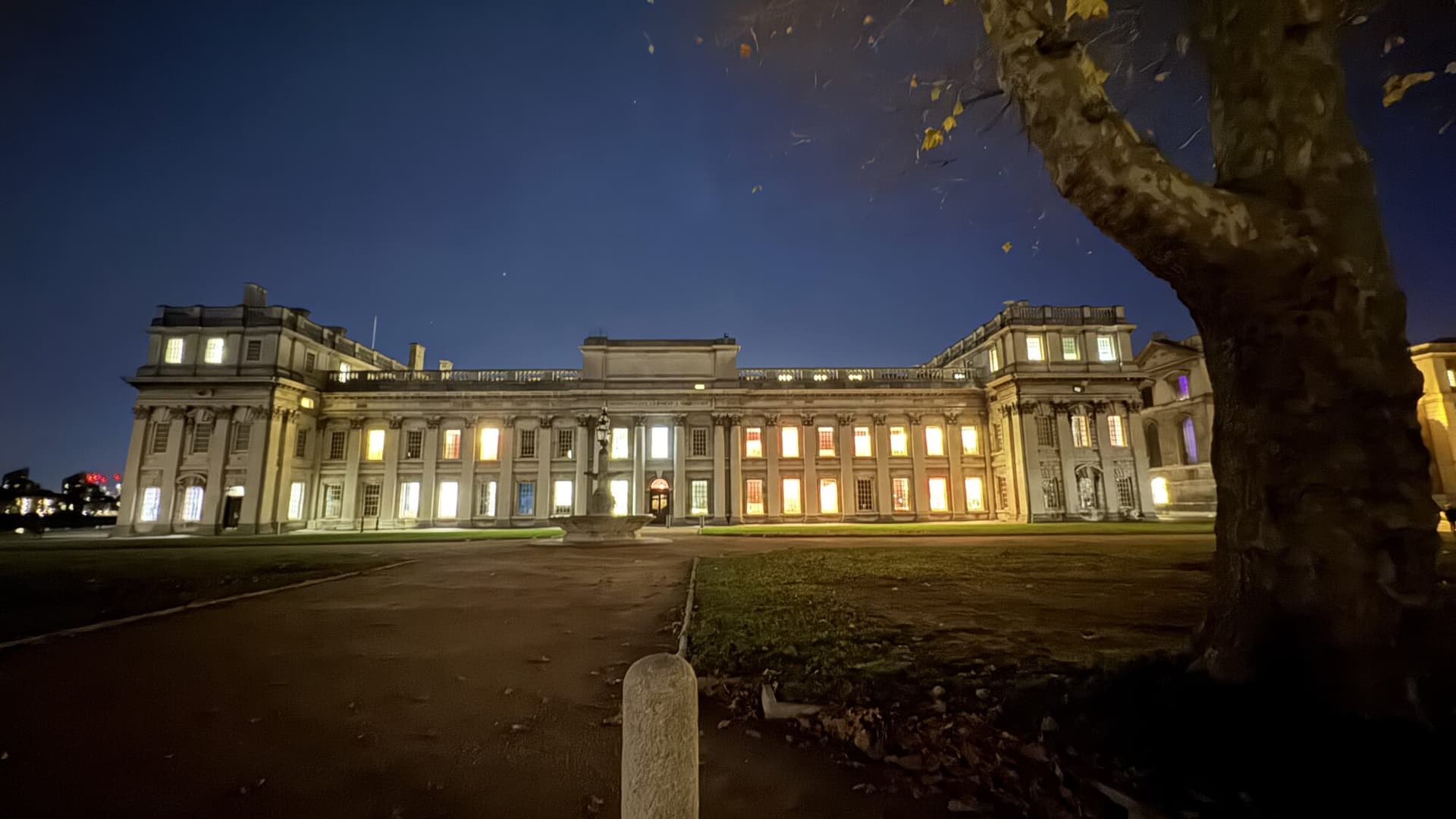
Arrival at the Old Royal Naval College before Time by Luxmuralis, façade glowing softly against the clear night sky
Before even entering the route of the experience, the approach to the Old Royal Naval College sets the tone: the long classical façade lit from within, framed by the dark sky, feels like the threshold to a different temporal register.
Officially, the installation is described as an immersive light and sound experience exploring our relationship with the concept of time, unfolding from the King William Undercroft, through the Ripley Tunnel, Queen Mary Undercroft and Chapel, before spilling out across the colonnades and into the courtyard
(event details and tickets here and the full description on ornc.org).
In practice, it is a slow and deliberate unravelling — not of a story, but of perception.
Painted Hall: Connection, Identity and Peter Walker’s Contribution
Luxmuralis is the artistic collaboration between sculptor Peter Walker and composer David Harper, known for transforming cathedrals, churches and heritage sites into large‑scale fine art experiences where light and sound become sculptural materials
(Luxmuralis overview on ornc.org).
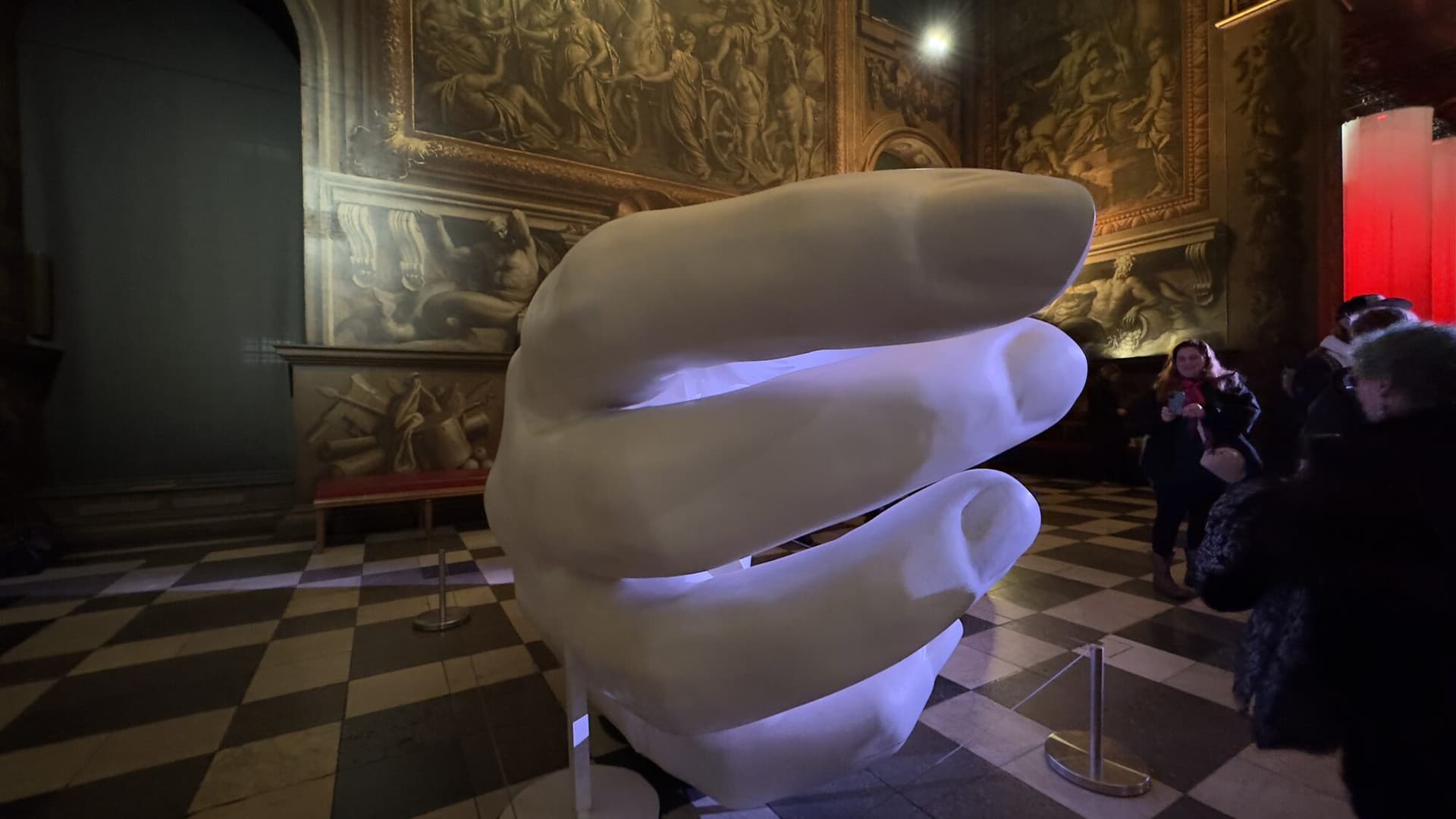
Large sculptural hand by Peter Walker illuminated within the Painted Hall, against Baroque murals and chequered floor
At Greenwich, the Painted Hall becomes a crucible for their ideas. Walker’s work — including the related Connection and Identity installations — adds another layer to the already dense iconography of the space
(see also the Old Royal Naval College’s description of Connection and Identity).
Inside this Baroque masterpiece, history is no longer static. Allegorical paintings dissolve into colour fields and then re‑emerge, as if time were folding in on itself.
The light does not simply illuminate the architecture; it edits it, erases it and redraws it in a different tempo.
Tiny human figures lean back, necks extended, trying to read an almost cosmic script from the ceiling — a perfect stage for Walker’s questions about connection, identity and our place within such overwhelming architecture.
Rather than competing with the historic paintings, the projections breathe between them, adding a temporal layer that feels both respectful and quietly radical.

View along the Painted Hall with green light columns and monumental hand sculpture under the ceiling paintings
Seen from a distance, the monumental hand sculpture and the glowing columns of light align with the perspectival ceiling, as if the Baroque architecture were actively reaching toward the present.
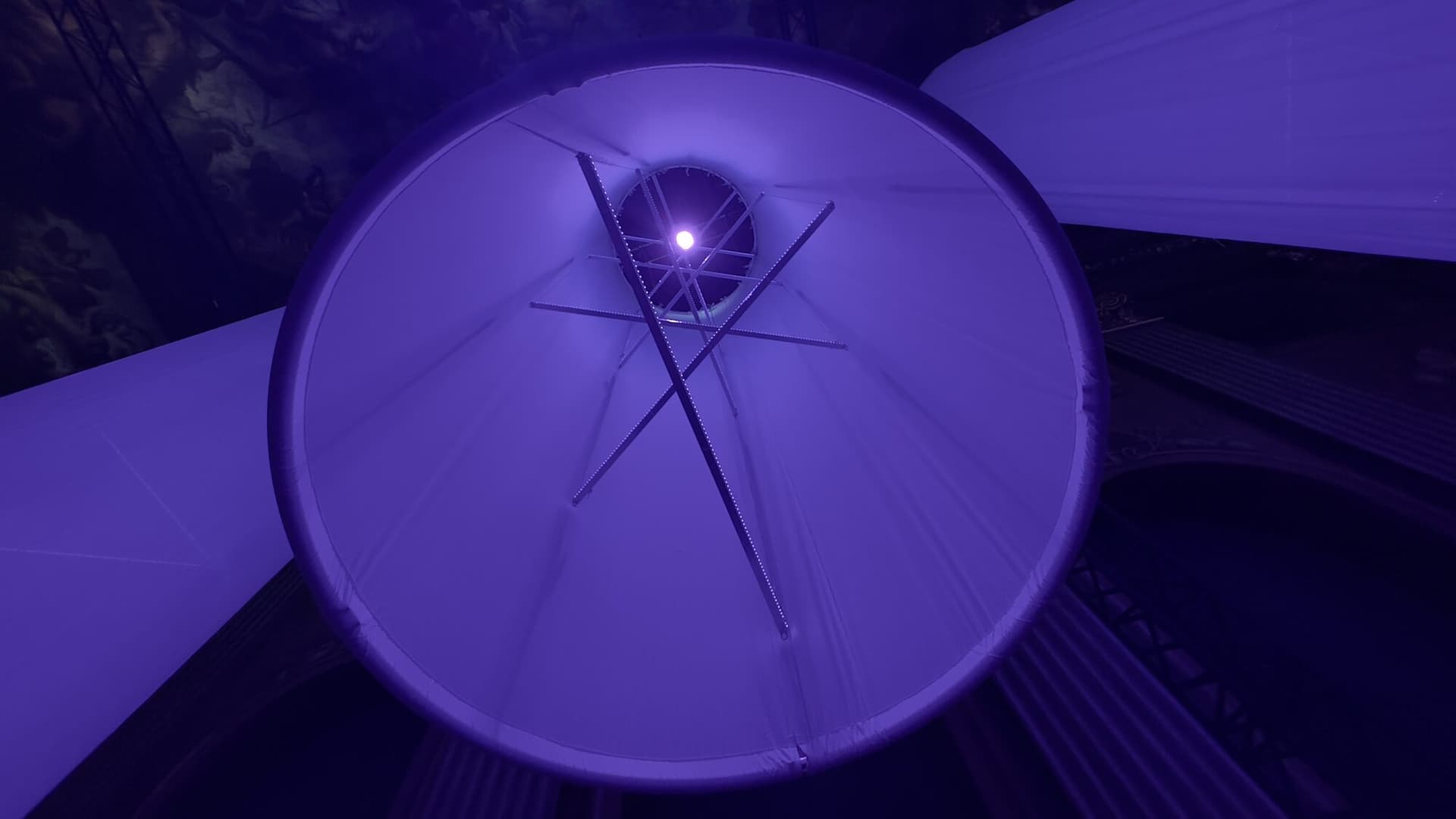
Cylindrical light column installation in the Painted Hall seen from below, glowing in deep violet
The vertical light structures act like contemporary frescos: floating, immaterial surfaces that echo the painted narratives above while adding a new, pulsing rhythm through the hall.
Immersive Journey Underground: King William Undercroft, Tunnels and Crypt
From the Painted Hall, you are drawn downwards into the King William Undercroft, where projections dissolve the boundaries between stone, image and sound.
Historic masonry becomes a living surface, gently pulsating as if the building itself were breathing.

Light textures washing over the vaulted ceilings of the King William Undercroft
Very quickly, bodies are reduced to silhouettes, folded into the projection field — temporary constellations in a choreography of moving light.
From there, you are carried through the Ripley Tunnel and into the Queen Mary Undercroft, each space tuned to a slightly different emotional frequency.

Data-like light projections covering the vaulted ceiling and columns of the crypt, numbers and symbols flowing across the space
In the crypt, projections of flowing numbers and symbols run across arches and columns, turning the chamber into a kind of data cathedral — a visualisation of time as information pulsing through space.

Wide projection mapping across an ORNC building, leading visitors from the crypt toward the chapel
Leaving the crypt, a monumental projection spreads across another wing of the Old Royal Naval College, like a moving fresco stretched over the entire façade — a visual bridge that gently pulls visitors toward the chapel.
The Chapel: Sound, Colour and the Intimacy of Scale
When you step into the chapel, the tone shifts from monumental to intimate. Voices, choral fragments and soundscapes envelop the space, yet nothing feels didactic. Instead of explaining time, the work allows you to feel its texture — stretched, compressed and suspended — in the gaps between notes and in the lingering afterglow of colour on stone.
The chapel becomes a luminous gradient where stained glass, projection and architecture melt into a single, vibrating surface. People stand still, almost reverent — not in front of an altar, but inside a volume of colour and resonance. As you linger, Gothic and classical lines are softened by drifting projections — like memories slowly resurfacing, anchored by light and sound.
Courtyard: Time Against the Night Sky
As you emerge from the interior galleries into the courtyard, the cold hits harder. Projections spill across the exterior façades, climbing columns and pediments and turning the Old Royal Naval College itself into a time instrument — a monumental clock whose hands are made of colour.
Outside, the building becomes a luminous palimpsest: history overwritten by data, starlight and human imagination. On the night I visited, the sky was perfectly clear. The projections did not erase the darkness; they conversed with it. Crossing the courtyard feels like passing through a luminous threshold — neither inside nor outside, suspended between architecture and cosmos.
From another angle, the same light reads differently, a reminder that perspective is one of our most human constraints.
Time as a Human Construct
Throughout the installation, fragments of text speak about time — how we measure it, how we fear it and how we try to own it. They hint at an uncomfortable truth: time is, in many ways, a human construct, a framework we invented to make sense of change. Nature does not segment itself neatly into hours, days and years; it moves in cycles, flows and transformations.

Close-up of projected text about time layered over architectural stonework
Philosophers and physicists have wrestled with these questions for centuries, from classical metaphysics to modern cosmology
(a starting point: the Time entry in the Stanford Encyclopedia of Philosophy). The universe, as far as we can grasp it, does not offer a simple beginning or end in the way our narratives do. We are simply not ready — not yet — to comprehend the universe exactly as it is.
Luxmuralis doesn’t lecture; it whispers. Text appears, dissolves and reappears — like thoughts you almost remember from a dream. At moments, the projections feel like constellations, data visualisations and sacred geometry all at once — a gentle suggestion that our models are always provisional.
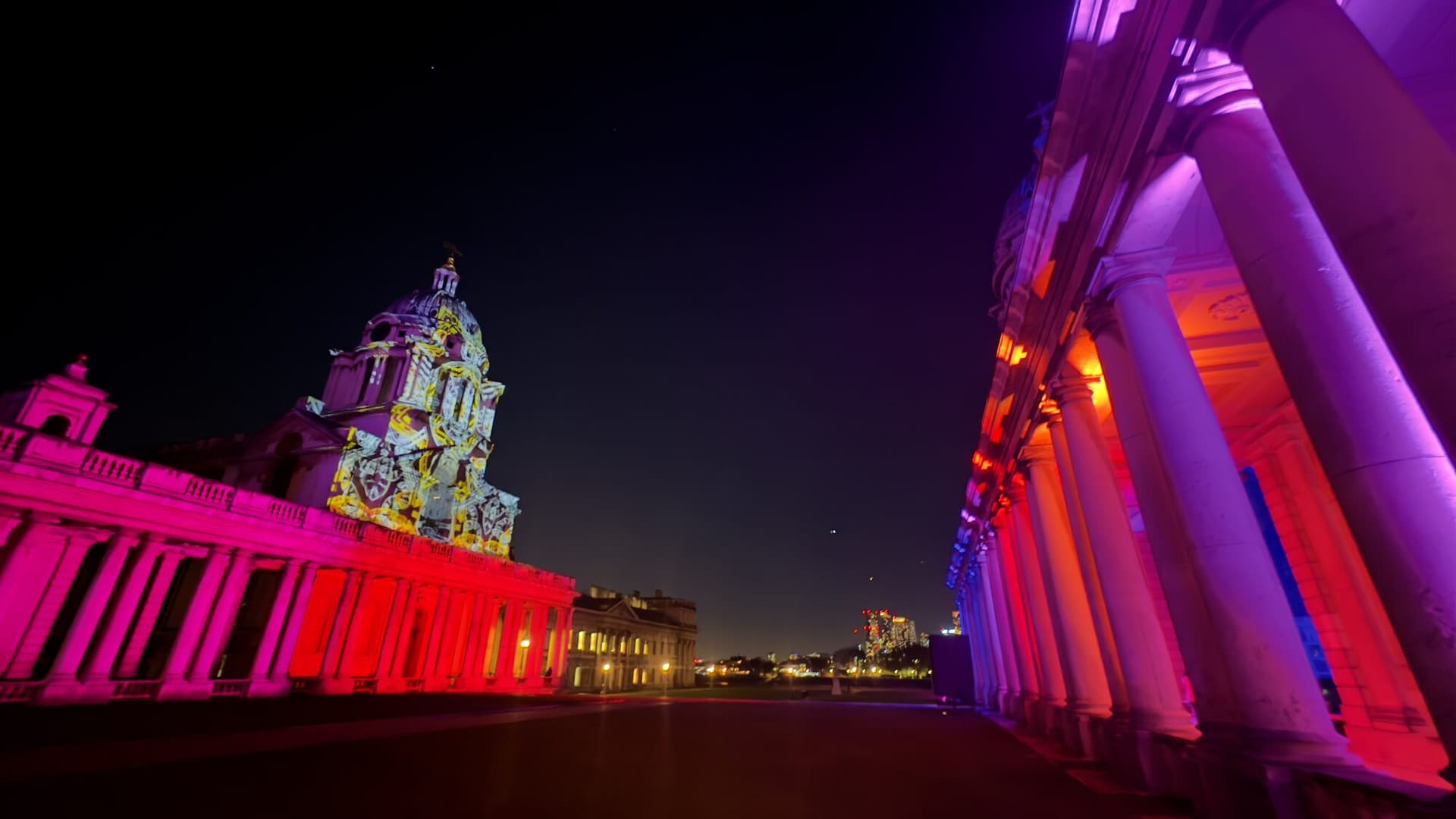
Abstract light forms echoing constellations and cosmic structures on the building surface
What Artists Might See
For artists, Time by Luxmuralis is almost a manifesto about what happens when you treat architecture as a living canvas.
The work demonstrates how sound, projection and historic fabric can be fused into a single medium — not as background “effects”, but as a serious, sculptural language.
An artist could read this installation as an invitation to:
- Think in terms of systems rather than objects — flows of light, sound and bodies rather than discrete pieces
- Use scale as a material: shrinking the human in order to expand awareness
- Collaborate across disciplines, trusting that music, architecture and light can speak in a shared syntax
It suggests a future where immersive work is not just spectacle, but a carefully tuned emotional and philosophical instrument.
What Collectors Might See
For collectors, especially those drawn to experiential or site‑specific work, Luxmuralis offers a different kind of proposition.
You cannot “own” the Old Royal Naval College, the night sky or the cold air — but you can recognise that the most powerful works now often exist between objects and in shared experience.
Collectors might see:
- How institutions are increasingly commissioning time‑based, immersive projects that reframe historic sites for new audiences
- How artists like Peter Walker and David Harper build a recognisable signature across multiple locations, much like a painter might across a series
- How documentation, editions, sketches and related works can become touchpoints for collecting, while the heart of the work remains public and ephemeral
In that sense, Time by Luxmuralis acts as a gentle reminder that collecting today is as much about supporting experiences as it is about acquiring objects.
A Quiet REVELAtion
There is a quiet pun hidden in the experience: a kind of REVELAtion.
Not an explosive revelation that answers everything, but a subtle suggestion that we are part of something immeasurably vast, complex and beautiful — and that our current tools for understanding it are still painfully small.
And yet, the emotion it leaves you with is not despair, but grace.
For a moment, standing in the cold, surrounded by centuries of architecture and ephemeral light, it feels enough to simply be.
To recognise that we are part of something beautiful, and that our role may be less about control and more about resonance.
Perhaps that is the most powerful message of Time by Luxmuralis:
that we should allow ourselves to be beautiful — not by polishing the surface, but by applying our energy in its rawest form,
by refusing to over‑filter our senses, by letting ourselves explode with pure joy, even if only for a brief moment in a freezing Greenwich courtyard.
To never quite let go of that feeling.